

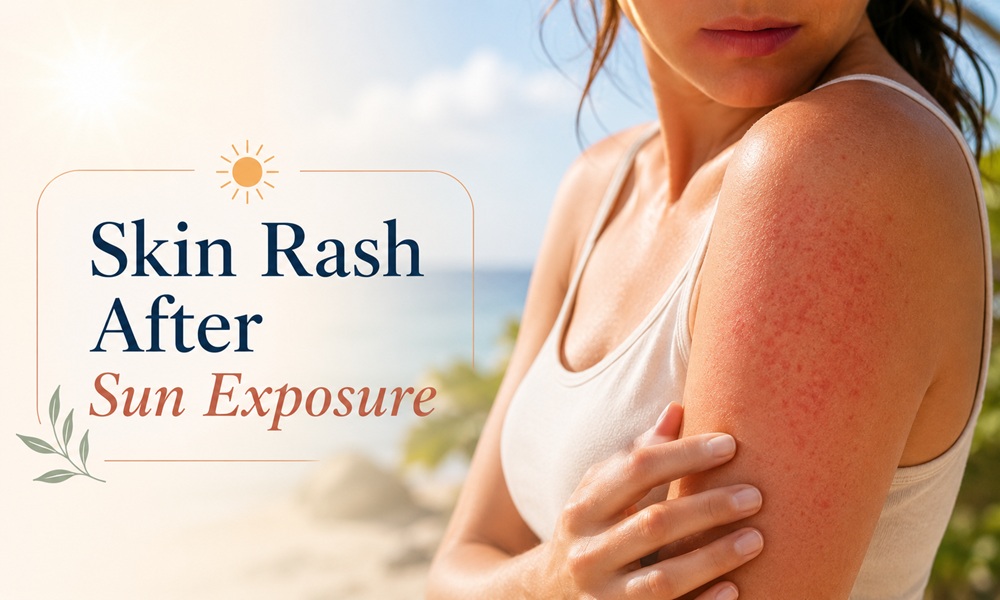
You spent 30 minutes outside, and within hours, your arms, chest, or neck have an itchy red rash with tiny bumps. This is one of the most common skin reactions to sunlight — and most cases are a condition called polymorphic light eruption (PMLE), also known as sun allergy or sun poisoning.
Most cases are completely manageable. Here is everything you need to know.
What Is Polymorphic Light Eruption (PMLE)?
PMLE is a non-life-threatening skin rash that appears after exposure to ultraviolet (UV) light. It is called “polymorphic” because it looks different in different people — red bumps, blisters, hives, or even patches that resemble eczema.
It typically appears within hours of sun exposure and resolves on its own in 1–2 weeks if you stay out of the sun.
Who Gets Sun Rash Most Often?
- Women more than men (about 3:1)
- Ages 20–40 most affected
- People in temperate climates — first sun of spring or summer is the biggest trigger
- People with fair skin (slightly more common but not exclusive)
- Anyone with a history of similar rashes
Symptoms of Sun-Triggered Skin Rash
- Itchy red bumps (2–5 mm)
- Burning or stinging sensation
- Small blisters or dry patches
- Rash on areas usually not exposed (arms, chest, neck, back of hands)
- Sometimes target-like or bull’s-eye patterns
- Face less commonly affected
- Rash usually fades within 7–14 days
Different Types of Sun-Related Skin Rashes
| Condition | Trigger | Key Sign |
| PMLE (sun allergy) | First strong sun exposure | Itchy bumps within hours |
| Solar urticaria | Any sun exposure | Hives in minutes |
| Sunburn | Excess UV | Red, painful, hot skin |
| Phytophotodermatitis | Plants + sun (lemon, lime, fig) | Blisters in plant-juice shape |
| Drug-induced rash | Medication + sun | Rash on exposed areas |
| Lupus rash | Sun on lupus patients | Butterfly face rash |
| Heat rash | Hot weather, blocked sweat | Prickly red bumps |
What Causes Sun Allergy?
The exact cause is unclear, but the leading theories are:
- Immune sensitivity — your immune system mistakenly identifies sun-altered skin proteins as foreign and attacks.
- Genetics — sun allergies often run in families.
- Photosensitizing substances — perfumes, lotions, certain plants, and medications make skin more reactive.
Medications That Make You More Sun-Sensitive
- Some antibiotics (tetracyclines, fluoroquinolones)
- Diuretics (hydrochlorothiazide)
- NSAIDs (naproxen, ibuprofen in some)
- Retinoids (acne treatments)
- Some antihistamines
- Certain diabetes medications
- Certain anti-cancer medications
If you take any of these and notice sun rashes, talk to your doctor — switching brands or timing may help.
Home Treatment: How to Soothe a Sun Rash
In the First 24 Hours
- Move out of the sun immediately.
- Cool the skin with a cold, damp cloth.
- Apply aloe vera gel — preferably refrigerated.
- Take a cool shower (not cold).
- Apply calamine lotion.
- Take an over-the-counter antihistamine (cetirizine or loratadine).
- Avoid scratching at all costs.
Over the Next Few Days
- Cover affected areas with loose cotton clothing.
- Stay out of direct sun completely.
- Keep the skin moisturized with fragrance-free cream.
- Use SPF 50+ if you must go outside.
- Drink plenty of water.
When You Need Medical Treatment
See a doctor if the rash is severe, widespread, or blistering, you have a fever along with the rash, the rash does not improve in 7 days, you have severe itching that does not respond to antihistamines, or you suspect a medication is the cause.
A doctor may prescribe topical corticosteroid creams, oral steroids for severe cases, phototherapy (controlled UV exposure to build tolerance), or hydroxychloroquine for some cases.
Prevention Strategies
Daily Habits
- Apply sunscreen SPF 50+ on all exposed skin.
- Reapply every 2 hours, especially after swimming or sweating.
- Apply sunscreen 15–30 minutes BEFORE going outside.
- Wear wide-brimmed hats and UV-blocking sunglasses.
- Choose tightly woven, light-colored clothing.
- Stay indoors between 11 AM and 3 PM when possible.
- Use UPF-rated clothing for outdoor activities.
Gradual Sun Exposure (Hardening)
Spending 5–10 minutes in early morning or late afternoon sun daily during early spring helps your skin build tolerance before summer hits — a strategy dermatologists call “hardening.” Do this slowly, with sunscreen on most of your body, gradually exposing more.
Skincare Products to Use vs. Avoid
| Use | Avoid |
| Fragrance-free moisturizer | Perfumes on exposed skin |
| Mineral sunscreens (zinc/titanium) | Citrus oils (lemon, bergamot) |
| Cooling aloe vera gel | Alcohol-based toners |
| Gentle cleansers | Strong exfoliants (AHA/BHA) |
| Calamine lotion | Retinoids before sun |
| Hydrating serums (hyaluronic acid) | Self-tanners with citrus extracts |
Foods That Help Protect Skin From Sun Damage
- Tomatoes — lycopene
- Carrots and sweet potatoes — beta-carotene
- Green tea — polyphenols
- Berries — antioxidants
- Dark chocolate (in moderation) — flavonoids
- Salmon and walnuts — omega-3
- Citrus fruits — vitamin C
- Watermelon — hydration + lycopene
FAQs
Is sun rash the same as sunburn?
No. Sunburn is direct UV damage; sun rash is an allergic or immune reaction to sunlight.
Will sun allergy go away on its own?
Each episode usually fades in 7–14 days. The condition often becomes milder over the years.
Can I prevent sun rash forever?
Not always, but most people drastically reduce flare-ups with sunscreen, clothing, and gradual sun exposure.
Are sun lamps and tanning beds safe if I have PMLE?
No — they often trigger flares. Avoid them.
Can children get PMLE?
Yes — there’s a variant called juvenile spring eruption that affects the ears in children.
