

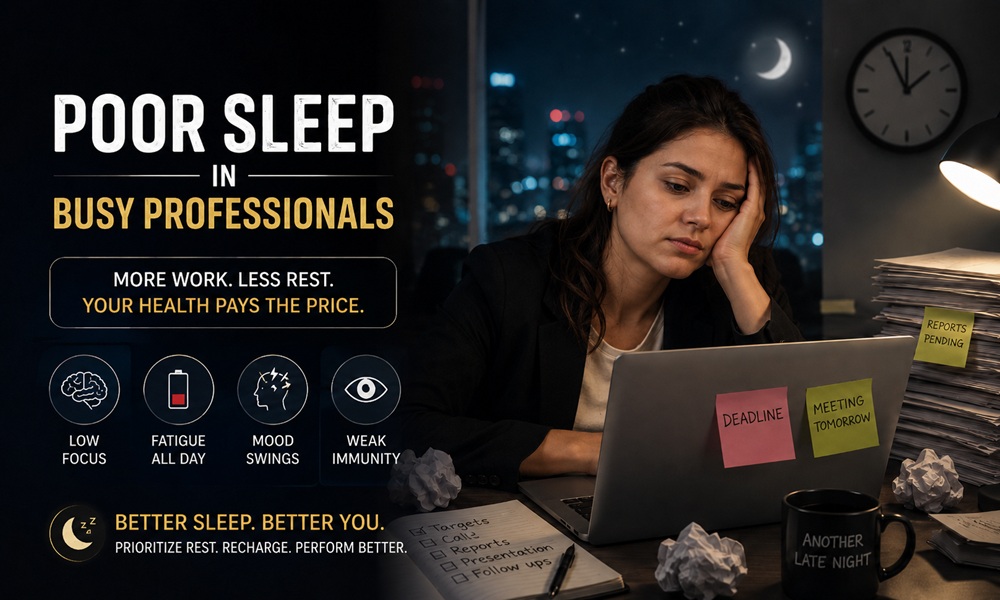
The Pattern Every Busy Professional Knows
Exhausted by 9 PM. In bed by 11. Lying awake at 12:30 AM mentally rehearsing tomorrow’s presentation. Finally asleep by 2. Up at 6:30. Foggy through morning. Caffeine. Push through. Repeat.
You’re not alone — and it’s not just stress. It’s a specific failure of the brain to transition from work mode to rest mode. The good news: it’s fixable with the right structure.
Sleep Architecture: What Actually Happens When You Sleep
Your brain doesn’t just ‘go offline’. It cycles through four stages, each 90 minutes long, each with a specific job.
| Stage | What Happens | Why It Matters |
| Stage 1 — Light | Drifting off, muscles relax | Transition only — not the goal |
| Stage 2 — Light | Heart rate slows, body temp drops | Memory consolidation begins |
| Stage 3 — Deep | Slowest brain waves, hardest to wake | Physical recovery, immune system, growth hormone |
| REM | Dreams, brain activity high, body paralyzed | Emotional regulation, learning, creativity |
You need both Deep and REM in quantity. Inconsistent bedtimes wreck both. Late dinners wreck Deep specifically. Late screens wreck REM specifically.
The Real Causes of Professional Sleep Trouble
Cause 1: The Cortisol Carryover
Stress doesn’t end when work ends. Cortisol levels stay elevated for 2–3 hours after a stressful event. If your last work email is at 9 PM, your cortisol is still telling your brain ‘alert mode’ at 11 PM. You can’t fall into deep sleep with that signal on.
Cause 2: No Mental Transition
Office → commute → home → dinner → bed. There’s no defined ‘work is done’ boundary. The brain keeps processing work problems even while you eat dinner and try to relax.
Cause 3: Inconsistent Bedtimes
Late nights on Tuesday, early Wednesday, late Friday, weekend lie-ins. Your circadian rhythm needs predictability. Vary bedtime by 1+ hour and Deep sleep drops measurably.
Cause 4: Screens as Bedtime Activity
Blue light suppresses melatonin for 1+ hour. But more importantly, doomscrolling, Netflix, work emails — all keep the brain in active-processing mode. The brain can’t transition with stimulating input.
Cause 5: Caffeine Half-Life
Caffeine has a half-life of 5–6 hours. A 4 PM coffee means half the caffeine is still active at 10 PM. Even if you fall asleep, sleep quality suffers.
Cause 6: Late Heavy Dinners
Active digestion competes with sleep. Eating past 9 PM means the body is breaking down food when it should be in restorative mode.
Cause 7: Bedroom Setup
Phones near the bed, TV in the room, work laptop within reach, bedroom too warm, ambient light from electronics. The bedroom subconsciously signals ‘work zone’, not ‘rest zone’.
The Cognitive Shutdown Ritual
A 30-minute pre-sleep structured routine that signals the brain that work is done. Used by physicians, executives, and high-stress professionals. Borrowed from CBT-I (Cognitive Behavioral Therapy for Insomnia).
Step 1 — Tomorrow’s List (10 minutes, around 9:30 PM)
- Open a notebook (paper, not screen)
- Write down everything on your mind for tomorrow
- Mark the top 3 priorities
- Write a clear ‘first task’ for the morning
- Close the notebook. Say out loud: ‘Work is done.’ (it’s silly, it works)
Step 2 — Physical Wind-Down (10 minutes)
- Dim all lights
- Warm shower or wash
- Light stretching — neck, shoulders, hamstrings
- Cool the bedroom to 18–20°C
- No screens past this point
Step 3 — Mental Wind-Down (10 minutes)
- Read fiction (not work-adjacent)
- Or guided meditation app (audio only)
- Or quiet conversation with family
- Or journaling — 3 things you’re grateful for
Step 4 — In Bed
- Phone in another room (or in airplane mode, face-down, across the room)
- Take 10 slow breaths counting backward from 10
- If thoughts come, notice them and return to breath
- If you can’t sleep in 20 minutes, get up, read in dim light, return
The 7-Day Sleep Reset Plan
| Day | Change to Make |
| Day 1 | Set a fixed bedtime (10:30 or 11 PM). Set an alarm. |
| Day 2 | Get 15 minutes of morning sunlight on waking |
| Day 3 | Last coffee by 1 PM. None after. |
| Day 4 | Dinner finished by 8:30 PM |
| Day 5 | Phone out of bedroom. Real alarm clock. |
| Day 6 | Start the full Cognitive Shutdown Ritual at 9:30 PM |
| Day 7 | Maintain everything; assess sleep quality |
Setting Up the Bedroom Right
- Cool: 18–20°C optimal
- Dark: blackout curtains; no LED lights on devices
- Quiet: white noise machine if street noise is an issue
- Comfortable: medium-firm mattress, cotton bedding
- Phone-free: dock it in another room
- Work-free: no laptop, no work bag in the bedroom
- Pet-free: pets disrupt sleep more than people realize
The Morning Half of the Equation
Sleep quality is set in the morning, not just at night.
- Wake at the same time every day, including weekends (within 30 min).
- Get 15–30 minutes of sunlight on the face within an hour of waking.
- Don’t check phone in first 30 minutes.
- Exercise within 2 hours of waking ideally.
- Breakfast with protein.
These five habits set your circadian rhythm cleanly. Night sleep falls into place much more easily.
Foods That Help You Sleep
- Warm milk with turmeric (small cup)
- Bananas — magnesium and tryptophan
- Almonds — magnesium
- Oats — slow-release carbs
- Chamomile or tulsi tea (no caffeine)
- Cherries — natural melatonin
- Light dinner of dal-rice or khichdi
Foods That Wreck Sleep
- Coffee, energy drinks, strong tea after 1 PM
- Alcohol — disrupts REM sleep severely
- Heavy spicy dinners
- Late-night sugar
- Excessive water 90 minutes before bed (wakes you for the bathroom)
- Chocolate close to bedtime
The Weekend Trap
Many professionals sleep 6 hours on weekdays and 10 on weekends, thinking they’re ‘catching up’. They’re not. Sleep debt doesn’t recover that way. Inconsistent wake times disrupt circadian rhythm and lead to ‘social jet lag’ — making Monday feel awful.
Better: same wake time daily, take a 20-minute nap if absolutely exhausted on the weekend.
| When to See a Doctor
Persistent insomnia despite consistent good habits for 4 weeks. Loud snoring with daytime fatigue (could be sleep apnea — common and serious in professionals). Falling asleep during the day uncontrollably. Severe anxiety preventing sleep. Use of sleep medication for more than 2 weeks. These deserve professional assessment. |
FAQ
Q: Why am I exhausted but can’t fall asleep?
A: Most likely cortisol carryover from late stress. Your brain registers exhaustion (low energy) but is still in ‘alert mode’ (high cortisol). The Cognitive Shutdown Ritual specifically addresses this dual state.
Q: Are sleep apps and trackers useful?
A: Modestly. They help identify patterns and show progress, but obsessing over the data can itself cause sleep anxiety (‘orthosomnia’). Use them as a tool, not a verdict.
Q: How long until consistent sleep changes work?
A: Most people notice improved sleep quality within 7–10 days of consistent habits. Full circadian rhythm reset takes 3–4 weeks. Sleep debt repayment takes 8+ weeks of consistent good sleep.
