

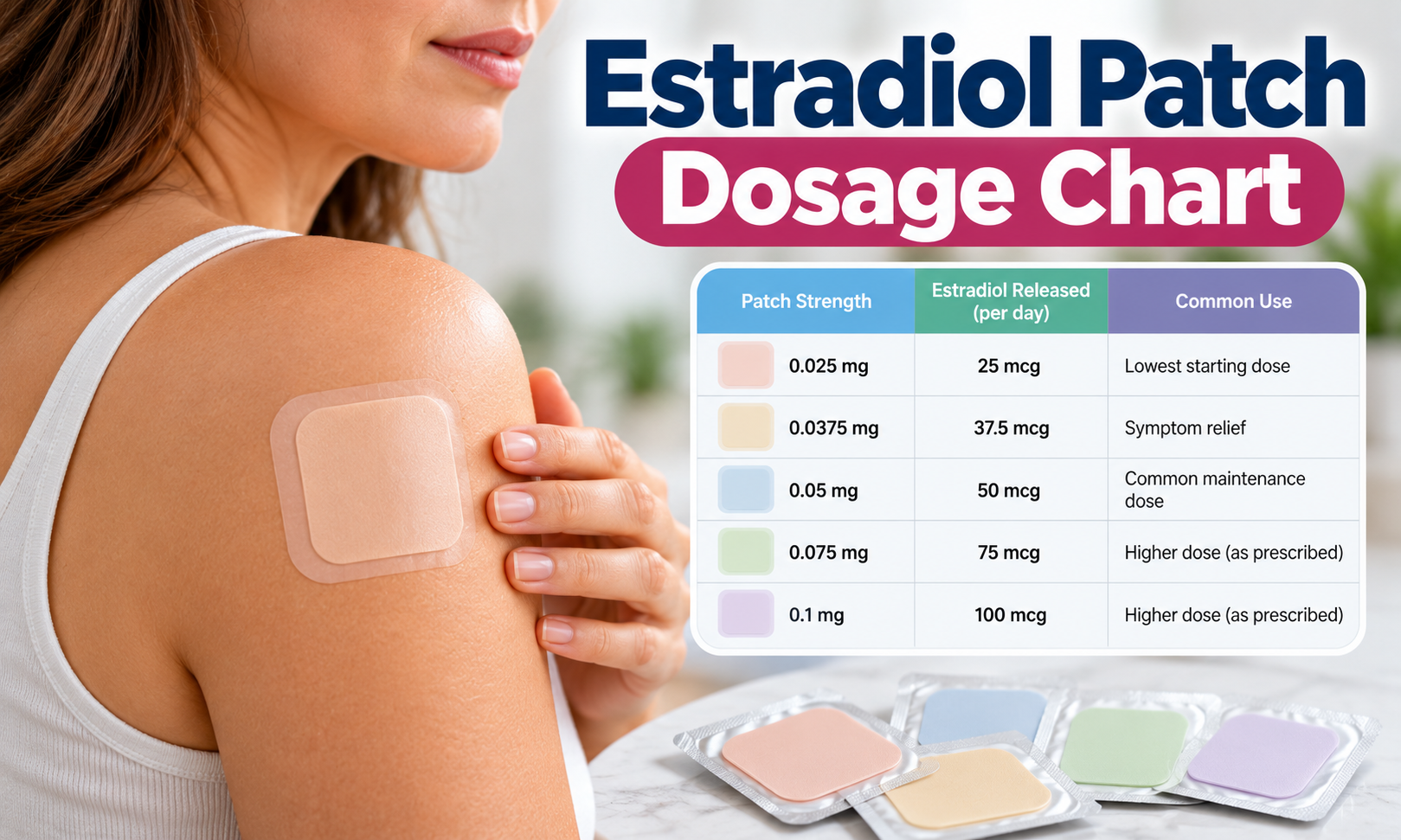
An estradiol patch dosage chart can help explain the strengths available in the United States, but it should not be used to choose or change a prescription on your own. Estradiol patches deliver estrogen through the skin and are commonly used for moderate to severe menopausal hot flashes, night sweats, and, in some products, prevention of postmenopausal osteoporosis.
For menopause symptoms, clinicians generally aim for the lowest effective dose that controls symptoms. Healthline’s overview of low-dose estrogen for menopause discusses this principle, while FDA-approved transdermal products are available in several delivery rates.
Estradiol Patch Dosage Chart
| Patch Delivery Rate | Approx. Micrograms/Day | Common Role | Typical Patch Schedule* |
| 0.025 mg/day | 25 mcg/day | Very low dose; often used for osteoporosis prevention and sometimes symptom control | Once or twice weekly, depending on product |
| 0.0375 mg/day | 37.5 mcg/day | Low dose; a common starting dose for vasomotor symptoms in twice-weekly products | Often twice weekly |
| 0.05 mg/day | 50 mcg/day | Standard systemic dose for symptom relief in many patients | Once or twice weekly |
| 0.075 mg/day | 75 mcg/day | Higher dose when lower doses do not adequately control symptoms | Once or twice weekly |
| 0.1 mg/day | 100 mcg/day | Highest commonly marketed systemic patch strength | Once or twice weekly |
*The replacement schedule depends on the specific brand or generic product. Do not assume two patches with the same delivery rate are changed on the same schedule.
What Is the Lowest Estradiol Patch Dose?
Among commonly marketed systemic estradiol patches, 0.025 mg per day, or 25 micrograms per day, is one of the lowest available strengths. However, the lowest available strength is not automatically the correct starting dose for every person.
For example, FDA labeling for a twice-weekly estradiol transdermal system lists 0.0375 mg per day as the starting dose for moderate to severe menopausal vasomotor symptoms and 0.025 mg per day as the starting dose for prevention of postmenopausal osteoporosis. Dose adjustments are based on symptom response and tolerability.
The FDA prescribing information for twice-weekly estradiol transdermal systems lists available strengths of 0.025, 0.0375, 0.05, 0.075, and 0.1 mg per day.
How Do Once-Weekly and Twice-Weekly Patches Differ?
The number on the patch refers to the amount of estradiol delivered each day, not how often the patch is replaced. Some products are designed to be changed once every seven days, while others are changed twice each week.
For example, some once-weekly systems are sold in strengths ranging from 0.025 to 0.1 mg per day. Several twice-weekly systems use similar delivery rates. Because patch construction and wear time differ, follow the exact instructions for your prescribed brand or generic product.
How Is the Right Dose Chosen?
Clinicians consider symptom severity, age, time since menopause, medical history, uterus status, medication interactions, side effects, and personal preferences. The goal is not to reach a particular blood estradiol number for routine menopause treatment. Instead, treatment is usually adjusted according to symptom relief and safety.
A lower dose may be enough for mild to moderate hot flashes, while some people need a higher dose for adequate control. If symptoms improve, clinicians may periodically discuss whether the dose can be reduced. Hormone therapy should be reassessed regularly rather than continued automatically at the same dose forever.
Do You Need Progesterone With an Estradiol Patch?
If you still have a uterus and use systemic estrogen, a progestogen is usually prescribed as well unless there is a specific medical reason not to. Unopposed systemic estrogen can stimulate the uterine lining and increase the risk of endometrial hyperplasia and endometrial cancer.
People who have had a hysterectomy generally do not need a progestogen solely for endometrial protection, although individual circumstances vary.
The Menopause Society’s hormone therapy guidance explains that systemic hormone therapy may use estrogen alone or estrogen plus a progestogen depending on whether the uterus is present and other clinical factors.
What Symptoms Can an Estradiol Patch Treat?
Systemic estradiol patches are most commonly used for vasomotor symptoms such as hot flashes and night sweats. They can also help some sleep disturbances that are driven by night sweats and may help prevent bone loss in appropriate patients.
Vaginal dryness, painful sex, and urinary symptoms may respond to systemic estrogen, but low-dose vaginal estrogen is often preferred when genitourinary symptoms are the only concern because it delivers much less estrogen to the rest of the body.
Where Should the Patch Be Applied?
Most estradiol patches are applied to clean, dry skin on the lower abdomen or buttocks. The exact approved location depends on the product. Patches should generally not be placed on the breasts, irritated skin, or areas where tight clothing may rub them off.
Rotate application sites to reduce skin irritation. Avoid lotions, oils, and powders where the patch will be placed because they may interfere with adhesion.
What Are Common Side Effects?
Possible side effects include breast tenderness, headache, spotting or vaginal bleeding, nausea, bloating, and skin irritation where the patch is applied. Some effects improve after the body adjusts, but new or persistent symptoms should be discussed with the prescriber.
Who May Need to Avoid Systemic Estrogen?
Systemic estrogen is not appropriate for everyone. FDA labeling lists important contraindications that can include unexplained vaginal bleeding, certain estrogen-sensitive cancers, active or previous blood clots, stroke or heart attack, certain clotting disorders, significant liver disease, and pregnancy.
Risk depends on individual history, age, route of estrogen, dose, and whether a progestogen is used. A clinician should review personal and family history before prescribing hormone therapy.
Does a Patch Have Different Risks Than an Estrogen Pill?
Transdermal estradiol bypasses first-pass metabolism in the liver, which changes its effect on clotting factors and triglycerides compared with oral estrogen. Observational research suggests transdermal estrogen may have a lower risk of venous blood clots than oral estrogen in some patients, although hormone therapy still requires an individualized risk assessment.
The patch is not automatically safer for every person. A history of breast cancer, unexplained bleeding, thromboembolic disease, or other contraindications may still make systemic hormone therapy inappropriate.
How Often Should the Dose Be Reviewed?
The dose should be reviewed after starting therapy and periodically thereafter. If symptoms remain bothersome, the prescriber may adjust the dose. If symptoms are controlled, a lower dose may sometimes be tried. The decision should be based on symptom burden, side effects, medical history, and personal preferences.
Do not cut an estradiol patch unless the manufacturer specifically states that the product can be cut. Patch designs differ, and cutting some systems can alter drug delivery.
When Should You Seek Medical Care?
Contact your healthcare professional for new or unusual vaginal bleeding, persistent breast changes, severe headaches, significant skin reactions, or symptoms that are not improving.
Seek urgent care for chest pain, sudden shortness of breath, coughing up blood, one-sided leg swelling, sudden weakness or numbness, trouble speaking, severe vision changes, or other possible signs of a blood clot, stroke, or heart attack.
Frequently Asked Questions
Is 0.025 mg the lowest estradiol patch dose?
It is one of the lowest commonly available systemic patch strengths in the United States. Whether it is appropriate depends on the indication, product, symptoms, and medical history.
Is 0.05 mg considered a high dose?
A 0.05 mg per day patch is generally considered a standard systemic dose rather than the highest dose. Higher commonly marketed strengths include 0.075 and 0.1 mg per day.
Can I start with the lowest patch dose for hot flashes?
Some people do well on a low dose, but FDA labeling for certain twice-weekly products lists 0.0375 mg per day as the starting dose for vasomotor symptoms. Your prescriber should choose the starting dose.
How long does an estradiol patch take to work?
Some people notice improvement in hot flashes within days, while fuller benefit may take several weeks. If symptoms remain troublesome, talk with your clinician rather than increasing the dose yourself.
Do estradiol patches cause weight gain?
Menopause itself is associated with body-composition changes. Hormone therapy is not generally considered a direct cause of major weight gain, although fluid retention and bloating can occur.
Can I use an estradiol patch without progesterone?
If you have a uterus, systemic estrogen is usually paired with a progestogen for endometrial protection. People without a uterus often use estrogen alone, but treatment should be individualized.
Bottom Line
Estradiol patches in the United States commonly deliver 0.025, 0.0375, 0.05, 0.075, or 0.1 mg of estradiol per day. The best dose depends on why the patch is being used, how well symptoms respond, and individual medical risks. A 0.025 mg per day patch is among the lowest systemic strengths, but certain twice-weekly products recommend 0.0375 mg per day as the initial dose for menopausal hot flashes. Use an estradiol patch only at the strength and schedule prescribed, and review ongoing need and dose with a healthcare professional.
