

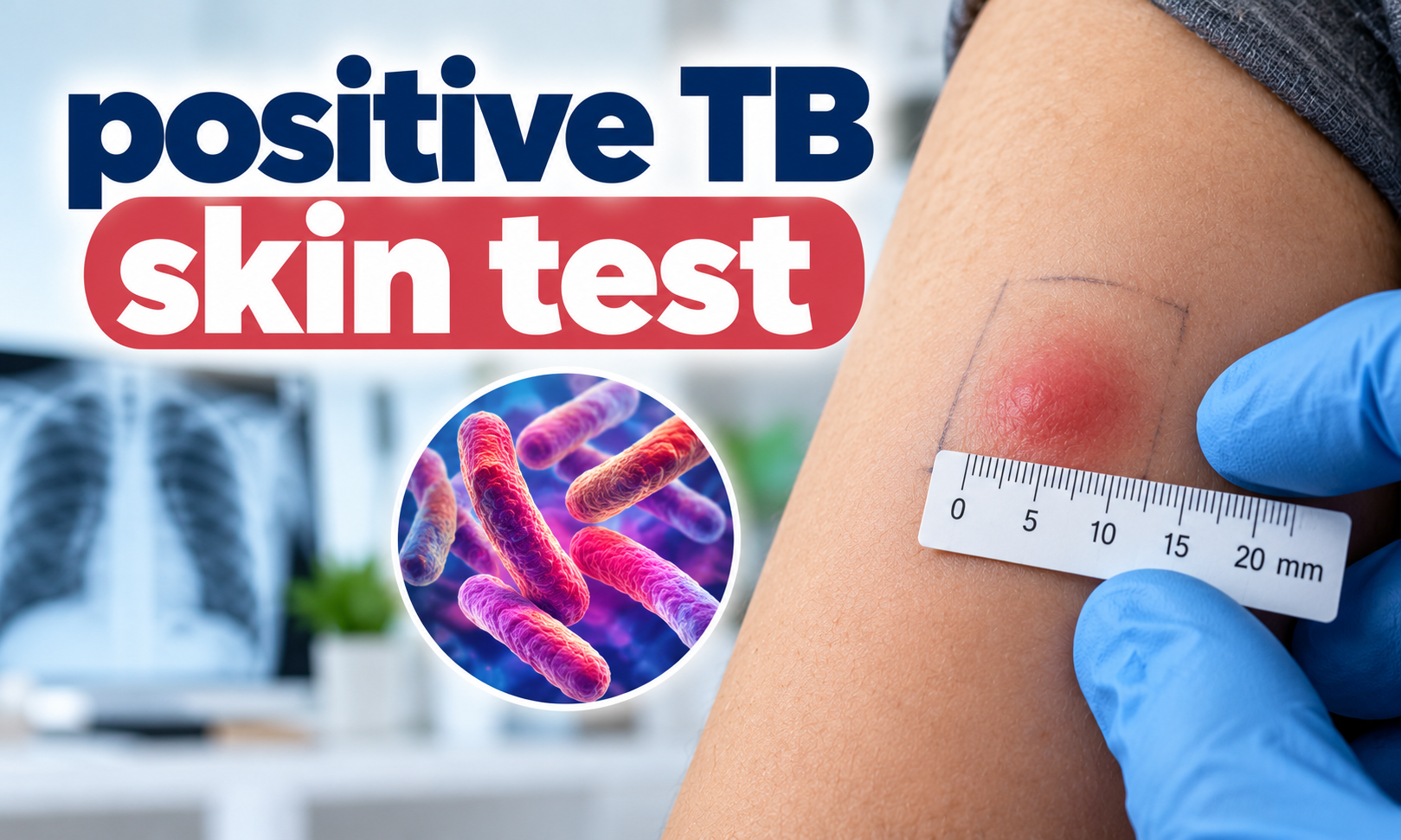
A positive TB skin test means your immune system reacted to tuberculin, which can indicate infection with the bacteria that cause tuberculosis. The test does not simply depend on redness. A healthcare professional looks for a firm, raised area called induration and measures it in millimeters 48 to 72 hours after the test is placed.
Whether a positive TB skin test is considered positive depends on both the size of the induration and your individual risk factors. A positive result means further evaluation is needed, but it does not automatically mean you have contagious or active TB disease.
What Does a Positive TB Skin Test Look Like?
A positive reaction may look like a firm bump or swollen area at the injection site on the forearm. The skin may also be red, pink, or darker than the surrounding skin, but color is not what determines the result. The important feature is the induration, which is the hardened, raised area that can be felt with the fingertips.
A healthcare professional measures the widest part of the induration across the forearm, usually perpendicular to the long direction of the arm. The measurement is recorded in millimeters. Redness without a measurable firm area is not counted as a positive reaction.
How Is a TB Skin Test Read?
The Mantoux tuberculin skin test, sometimes called a PPD test, is performed by injecting a small amount of purified protein derivative just under the skin of the forearm. A small pale bump usually appears immediately after the injection. That initial bump is expected and is not the final test result.
You must return to a healthcare professional 48 to 72 hours later. The test should not be interpreted at home by measuring redness with a ruler or comparing the arm with online photographs.
According to the CDC’s tuberculin skin test guidance, the cutoff for a positive result varies because people with a higher risk of TB infection or progression to active disease require a smaller amount of induration to meet the positive threshold.
| Induration | When It May Be Positive | Examples |
| 5 mm or more | Positive in certain high-risk people | HIV, recent TB contact, organ transplant, major immunosuppression, or prior-TB changes on chest X-ray |
| 10 mm or more | Positive in people with specified TB risk factors | People from countries where TB is common, high-risk settings, certain medical conditions, lab workers, and young children |
| 15 mm or more | Positive even without known TB risk factors | People with no identified TB risk factors |
Does Redness Mean the TB Test Is Positive?
No. Redness can occur after the injection and may look dramatic, but it is not the measurement used to classify the test. A clinician feels the skin to identify the edges of the firm induration and measures that area only.
For the same reason, a large red patch with little or no firmness may still be recorded as zero millimeters of induration. A smaller-looking area that feels clearly firm and raised may be clinically more important.
Does a Positive TB Skin Test Mean You Have Active Tuberculosis?
No. A skin test can show that your immune system has been exposed to TB bacteria, but it cannot distinguish inactive, or latent, TB infection from active TB disease.
People with inactive TB infection generally feel well, have no symptoms, and cannot spread TB bacteria to other people. Active TB disease means the bacteria are multiplying and causing illness. When TB affects the lungs or throat, it can spread through the air.
| Feature | Inactive TB Infection | Active TB Disease |
| Symptoms | Usually none | May include cough, fever, night sweats, fatigue, chest pain, or weight loss |
| Can spread TB to others? | No | Possible, especially with pulmonary or throat TB |
| Skin or blood TB test | Usually positive | Often positive, although false negatives can occur |
| Chest X-ray | Usually does not show active disease | May show changes consistent with TB |
| Treatment | Recommended to reduce future risk of TB disease | Requires a multidrug treatment regimen |
What Happens After a Positive TB Skin Test?
The next step is a medical evaluation to determine whether the infection is inactive or whether active TB disease is present. Your clinician will review your symptoms, exposure history, medical conditions, medications, and previous TB testing.
A chest X-ray is commonly performed. If active pulmonary TB is suspected, sputum samples may be tested with microscopy, molecular testing, culture, and drug-susceptibility testing. Culture remains an important confirmatory test for active disease.
If the evaluation does not show active TB disease, the diagnosis may be inactive TB infection. Treatment is often recommended because it can substantially reduce the chance of developing active TB later.
What Symptoms Could Suggest Active TB?
The CDC lists common symptoms of active pulmonary TB as a cough lasting three weeks or longer, chest pain, and coughing up blood or sputum. Other possible symptoms include fever, chills, night sweats, fatigue, reduced appetite, and unexplained weight loss.
Having one of these symptoms does not prove TB, but a person with a positive TB test and symptoms that could fit active disease should be evaluated promptly. TB can also occur outside the lungs, so symptoms can vary depending on which part of the body is affected.
Can a TB Skin Test Be False Positive?
Yes. A false-positive result means the skin test is interpreted as positive even though the person is not infected with Mycobacterium tuberculosis.
Previous BCG vaccination, exposure to certain nontuberculous mycobacteria, or errors in administering or interpreting the test can cause false-positive results.
For people who received BCG, the CDC generally prefers a TB blood test, also called an interferon-gamma release assay or IGRA, because BCG vaccination does not make the blood test positive.
Can a TB Skin Test Be False Negative?
Yes. A negative skin test does not always rule out TB infection or disease. False negatives can happen after a recent infection before the immune system has had enough time to respond, in people with severe immune suppression, during severe illness, and in some very young children.
If you have TB symptoms or a recent close exposure, your clinician may order additional testing even when the skin test is negative.
What Treatment Is Used After a Positive Test?
Treatment depends on whether you have inactive TB infection or active TB disease. Active TB requires a clinician-supervised multidrug regimen.
For inactive TB infection, current US guidance favors shorter rifamycin-based regimens for many patients. The best option depends on age, pregnancy status, medications, drug interactions, and medical history.
Do not start, stop, or change TB medication without medical supervision. Active TB must be ruled out before starting treatment for inactive TB infection.
Should You Repeat the Skin Test After a Positive Result?
Usually not. Many people continue to have a positive TB skin test or blood test even after completing treatment. The CDC advises keeping written documentation of your positive result and any treatment you complete so future employers, schools, or healthcare providers know your history.
Future screening may use symptom review or other evaluation instead of repeating a test expected to remain positive.
Frequently Asked Questions
Is a raised red bump always a positive TB test?
No. The firm induration is measured, not redness alone. Whether the result is positive also depends on the size of the induration and your TB risk factors.
Can I measure my TB test at home?
You should not rely on self-measurement. A trained healthcare professional should read the test 48 to 72 hours after it is placed.
Is 10 mm always considered positive?
No. Ten millimeters or more is positive for specific risk groups. A person with no known TB risk factors generally requires 15 mm or more to meet the CDC threshold.
Can BCG vaccination cause a positive skin test?
Yes. BCG can cause a false-positive skin test. TB blood tests are preferred for people who have received BCG because the vaccine does not cause a positive IGRA result.
Can latent TB spread to my family?
No. People with inactive or latent TB infection do not spread TB bacteria. Active TB disease, particularly in the lungs or throat, may be contagious.
Will a positive TB test stay positive forever?
It often remains positive for many years and may stay positive even after successful treatment. Keep documentation of your result and treatment history.
Bottom Line
A positive TB skin test is determined by the size of a firm area of induration, not by redness alone. The cutoff may be 5, 10, or 15 millimeters depending on TB risk factors. A positive result shows evidence of TB infection but cannot determine by itself whether the infection is inactive or active. Follow-up evaluation, usually including a medical history and chest X-ray and sometimes sputum testing, is essential before treatment decisions are made.
